
Your child gets into the car after training and rubs a knee. Or walks in from the pitch with a small limp and says the heel hurts again. You think back to your own childhood, and the answer comes easily: it’s probably growing pains.
It’s a fair thing to think, and it’s partly right. But the classic growing pains doctors describe and the pain young athletes feel after sport are usually two different things, and you can often tell them apart at home. I work with young athletes and their parents here in Thessaloniki, and it’s one of the questions I hear most.
Two kinds of pain that share one name
Classic growing pains tend to come in the evening or at night. They’re usually felt in both legs, in the shins, calves or thighs rather than in a joint, and they’re gone by the morning. During the day, your child runs around as if nothing happened.
Pain that comes from sport looks different. It sits in one spot your child can point to with a finger: just below the kneecap, at the back of the heel, or at the front of the hip. It shows up during or after training, gets worse with running, jumping or stairs, and can feel stiff the next morning after a hard session. Sometimes there’s a small limp after a match.
If that second picture sounds familiar, it’s usually something different, and worth having looked at.
What’s happening inside a growing body
During a growth spurt, the bones grow first and the muscles and tendons take a while to catch up. Where a tendon meets the bone, there’s a growth area that is still soft at this age. With every sprint, jump and kick, the tendon pulls on that spot, and over time it gets irritated and sore. That’s why this pain is so common in football, basketball, gymnastics, running and dance, and why injury risk goes up during a growth spurt.
Where it hurts tends to follow age. In growing footballers, heel pain often shows up in the younger years, knee pain around 12, and hip pain more in the mid-teens. At the heel, it’s known as Sever’s. You may also hear “Sever’s disease”, but despite the name, it isn’t an illness. Just below the knee, it’s Osgood-Schlatter, and a small bump can form on the bone there. At the hip, the same pull happens where the big thigh and hip muscles attach to the pelvis.
The reassuring part is how it usually goes. For most kids, the pain eases within weeks to a few months once the training is adjusted. It can flare up again in the next growth spurt, and it settles for good once growth slows down and that soft area becomes solid bone. For some it drags on longer, especially when the training never changes.
Signs a doctor should check first
Pain that comes and goes with training is common in growing kids, and rarely dangerous. A few things don’t fit that picture, though, and they mean your child should see a doctor before any training plan:
- pain in one leg that isn’t linked to sport
- pain at rest or at night that keeps getting worse, or that is there in the morning even after a quiet day
- a limp that doesn’t settle by the next day, or not wanting to put weight on the leg
- swelling, redness or warmth around a joint
- a fever, unusual tiredness, weight loss or unexplained bruising
- sudden, sharp pain during a sprint, a kick or a fall
One more that many parents haven’t heard: a teenager with knee pain and a limp should also have their hip checked, because a hip problem can be felt in the knee.
I don’t diagnose. That’s a doctor’s job, and if your child hasn’t been seen yet, I’ll ask you to start there. If I notice any of these signs along the way, I’ll always send you back to a doctor first.
Does your child have to stop playing?
Not always, and often not completely. For most young athletes, the answer is to adjust the load, not stop everything. They keep doing what doesn’t hurt and ease off what does, for a while: fewer jumps and sprints, shorter sessions, or sitting out a less important match to be ready for the one that matters.
The principle I work with is simple. A little discomfort that settles by the next morning is usually fine. Pain that makes them limp, or feels worse the next day, means the load was too much, and we step back. What doesn’t help is playing through strong pain, which usually makes the whole thing last longer.
A soft heel cushion may ease heel pain in the first weeks. A day or two a week without organized sport, and a proper break during the year, give a growing body time to catch up. And if the pain isn’t settling within a few weeks of easing off, get it looked at.
The part kids don’t always say out loud
For a young athlete, a sore knee is rarely just about the knee. Many are afraid of losing their place in the team, so they hide the pain or play it down. The coach wants them on the pitch on Saturday, and parents end up stuck in the middle. What often helps most is simply understanding what’s going on: their body is growing, this is common, and easing off for a few weeks doesn’t mean they’re out.
How I work with young athletes
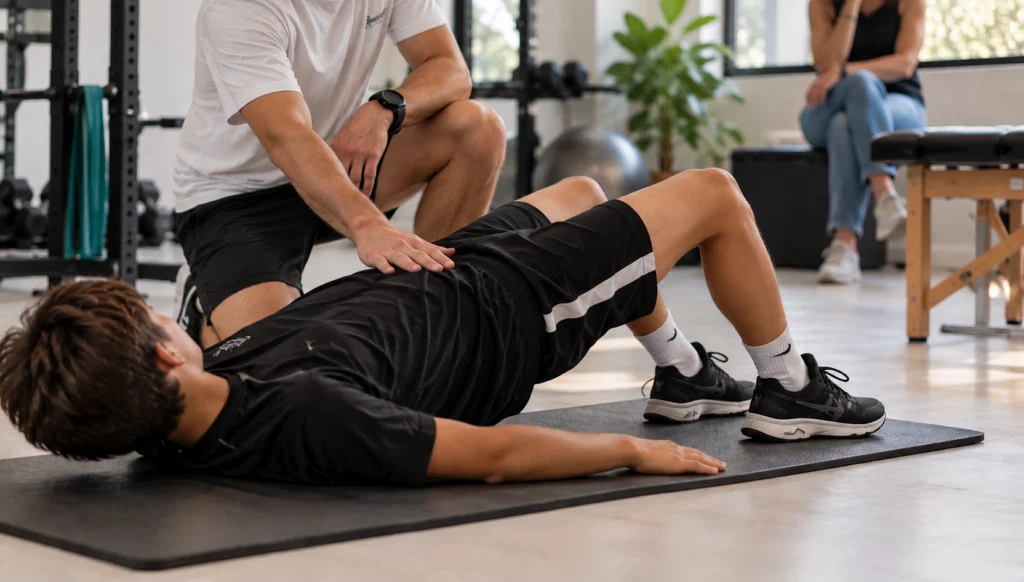
I help with the part that often gets left out after a doctor’s visit. That means working out how much training your child’s body can handle right now, building strength in the legs and hips step by step, easing tight thigh and calf muscles with gentle hands-on work, and planning a gradual way back to full training.
A parent or guardian stays with us for the whole session. And with your permission, I’m happy to talk to the coach, so the plan works on the pitch too, not only in our sessions.
Over the years I’ve guided young footballers, youth national team players among them, through long rehabs and back to their game. And I keep seeing the same thing: a young athlete who understands their body comes back more confident, not less.
Questions parents ask me
How long do Osgood-Schlatter and Sever’s last?
For most kids, the pain eases within weeks to a few months once the training is adjusted, though it can come back during a growth spurt until growth slows down.
Will the bump below the knee go away?
Not always. The bump can stay after growth ends, but it’s usually painless.
Is it growing pains if it hurts at night?
It can be. Classic growing pains often come at night, in both legs, can even wake a child up, and are gone by the morning. Night pain that fits this pattern usually isn’t a reason to worry. If it’s in one leg only, keeps getting worse, or comes with any of the signs above, a doctor should look first.
Growing at their own pace
Growing bodies ask for a bit of patience from everyone around them. These years pass, the soft growth areas turn to solid bone, and for most kids this pain becomes something they barely remember. Until then, the aim is to keep them moving, keep them playing where it makes sense, and let the training grow along with them.
If your child has been dealing with knee, heel or hip pain and you’d like help with the training side, come in together and we’ll plan the next few weeks.
Kfir Zilber is a sports therapist based in Thessaloniki, Greece,
specializing in sports injury rehabilitation and recovery.
Works with athletes, active people and sports teams.
Disclaimer: This article is for general information only and is not a substitute for medical advice, diagnosis or treatment. Please consult a doctor about any injury or medical concern.