
You know the feeling. A hard week of training is behind you, and your legs feel heavy on the stairs.
Your hips are tight after a long run. Or you’ve just stepped off a long flight and your legs feel like they belong to someone else.
That’s usually the moment people ask me about Recovery Boots.
They are one of the tools I use most in my clinic. Over more than ten years, I’ve worked with national team footballers, a mountain biker on an Olympic campaign, runners and Muay Thai fighters, and recovery has always been part of their plan. Still, the boots are often misunderstood. Some people see them as a luxury, others expect them to fix an injury on their own. The truth sits somewhere in between, and it’s worth understanding before you try them.
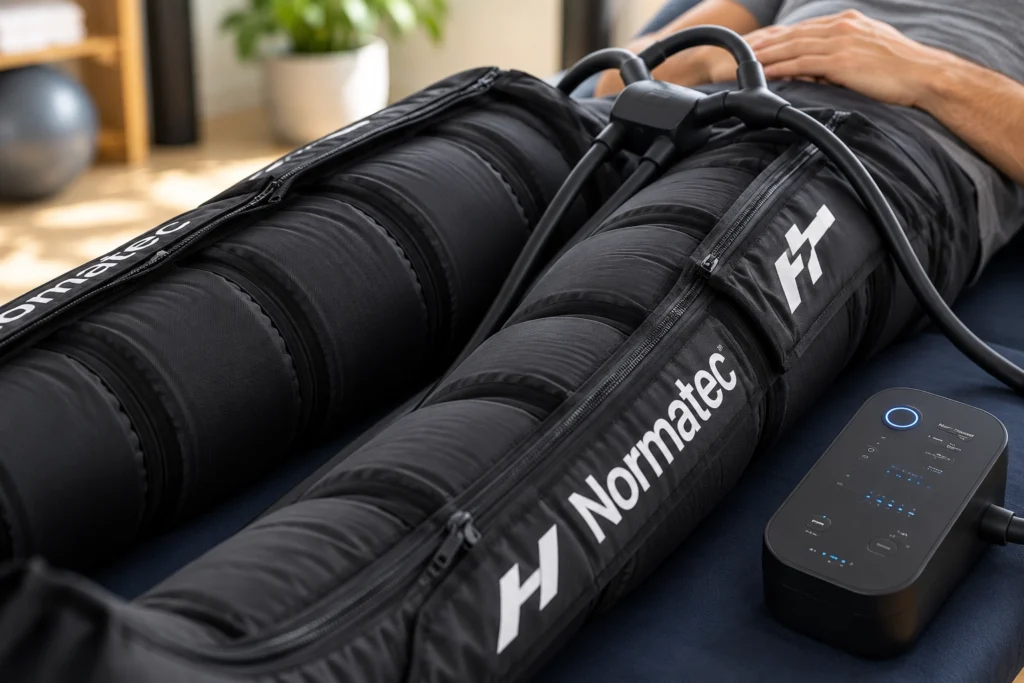
A gentle squeeze that moves up your legs
Recovery Boots (Normatec), often called compression boots, are soft sleeves that fill with air. In my clinic, they cover the full length of both legs, and a hip attachment reaches up over the hips, glutes and lower back.
You lie back, the sleeves inflate, and a wave of pressure starts at your feet and slowly travels upward toward your hips. Then it lets go, and the next wave begins.
It’s a simple idea. When you walk or run, your muscles naturally squeeze the veins in your legs and help send blood back toward the heart. The boots do something similar while you rest, so your legs get that support without any extra work from you.
It feels like a firm, rhythmic hug around your legs. It should never hurt, and most people find it surprisingly relaxing.
What you can expect, and what you shouldn’t
Here’s what I tell every athlete before their first session.
What people notice most is that their legs feel lighter and less sore. That heavy, tired feeling after hard training or a match eases, and they feel ready for the next session sooner. This is also where the research is clearest: the boots help reduce muscle soreness after hard exercise.
What they won’t do is heal an injury on their own, or make you faster or stronger overnight. They don’t replace good sleep, good food or a sensible training plan either. They work best as one part of a recovery routine, not the whole of it.
I’d rather you walk in with the right expectations than with a promise that doesn’t hold up.
Who they’re for
Anyone whose legs carry a heavy load can benefit, whether you’re a fighter, footballer, runner, cyclist, or someone who simply trains hard and wants to keep showing up week after week.
I see it most with fighters in fight camp, who run, spar and train twice a day. With footballers the day after a match, especially when another one is coming later that week. With runners and cyclists in their biggest weeks of training, like the build-up to the Alexander the Great Marathon here in Thessaloniki each spring. And with athletes in rehabilitation, whose legs are working hard to rebuild.
It’s also a quiet favorite among people who aren’t competing at all: after a long flight, a long day on their feet, or simply a week that asked a lot of their body.
When a session helps most
The best time is usually after training or a match, ideally not long after you finish. That’s when your legs need the help most, and when most athletes feel the biggest change.
A shorter, lighter session before training can also help your legs and hips feel loose, though it’s there to support your warm-up, not replace it. During a heavy training period, two or three sessions a week after your hardest days is a good rhythm. And after travel, a session helps ease the stiffness that comes from sitting for hours.
Better together with treatment
This is where the boots really earn their place.
When someone comes to me with an injury or a recurring problem, the boots are rarely the whole answer. They work alongside the treatment that targets the actual issue. For tight, overworked legs, I often pair them with Medical Massage. When there are trigger points in the calves, quads or glutes, with Dry Needling. For tendon problems like the Achilles or the knee, Shockwave Therapy treats the tendon while the boots help the legs recover from the training around it. And during rehab, a session after the exercise work helps the body absorb the effort.
The treatment deals with the problem. The boots support the recovery around it. Together, they help you get back to training with a body you can trust.
What a session looks like
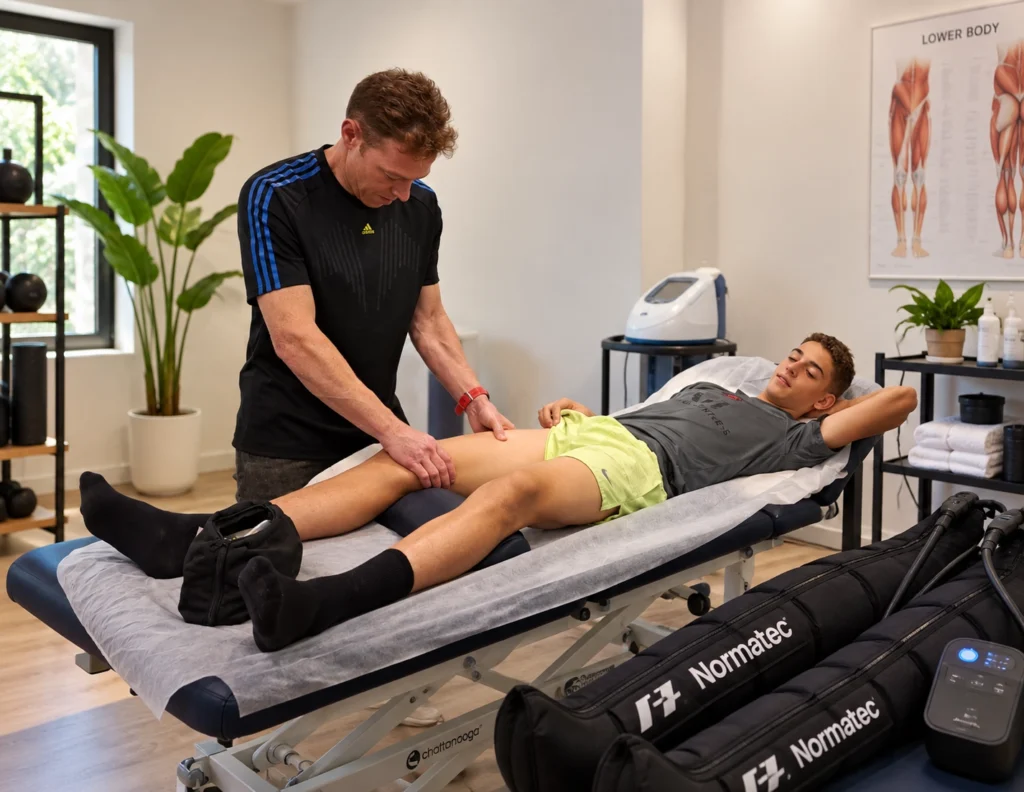
A session in the boots takes about 30 minutes.
We start with a short conversation: how your training is going, how your legs feel, any injuries, and a few health questions to make sure the boots are right for you. Then you lie back in your training clothes, the sleeves go on, and we find a pressure that feels good. On a first session I start gently and adjust as we go, depending on how your body responds that day.
After that, you simply rest. Most people read, scroll or close their eyes. When the half hour is up, you stand up with legs that feel lighter and looser than when you came in.
If you’re combining the boots with another treatment, we plan the whole session together.
A quick word on safety
For most healthy, active people, the boots are completely safe. But there are times they’re not the right choice.
Please don’t use them, and let me know before your session, if you have a blood clot or suspect one, a history of a clot in the lungs, a serious heart condition, an infection, wound or skin problem on your legs, a fracture in the area, or poor circulation in your legs. If you have high blood pressure, a heart or circulation condition, or you’re pregnant, check with your doctor first. And after surgery, only with your surgeon’s approval.
That’s exactly why we talk before your first session. Good recovery always starts with safety.
In an athlete’s words
Aya, a Muay Thai fighter, used the boots alongside physiotherapy during fight preparation:
“My legs felt lighter and I generally felt much more recovered after hard training and running sessions.”
That’s really the whole point. Not a miracle, just a body that feels ready to train again.
Make recovery part of the plan
The athletes who stay consistent are usually the ones who take recovery as seriously as training.
Not as a reward at the end of a hard week, but as part of the work itself.
If you’d like to try Recovery Boots, or combine them with treatment for an injury, I’d be glad to help.
Kfir Zilber is a sports therapist based in Thessaloniki, Greece,
specializing in sports injury rehabilitation and recovery.
Works with athletes, active people and sports teams.
Read More About Kfir